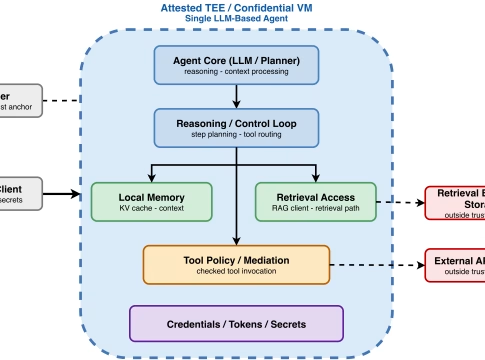

Artificial intelligence is shifting rapidly from passive text generation to autonomous action. Modern AI agents now execute software code, query corporate databases, and interact directly with customers. However, this sudden autonomy exposes enterprise systems to severe vulnerabilities. When an agent accesses internal tools and sensitive records, conventional cyber defenses quickly fall short. Traditional encryption protects data at rest and data in transit, but it leaves active memory vulnerable to compromise.
To address this critical security gap, the technology industry is rallying around a powerful isolation framework: confidential computing. By sealing workloads inside hardware-protected memory vaults, organizations can deploy autonomous systems without exposing intellectual property or customer privacy. As highlighted in recent reporting from Computerworld, rising anxieties around autonomous agent behaviors are driving rapid mainstream adoption of confidential computing across enterprise clouds.
Key Takeaways (TL;DR)
- The Blind Spot of Classic Security: Standard encryption protects data during network transmission and on storage disks, but leaves it exposed in active system memory.
- Hardware-Enforced Isolation: Confidential computing utilizes Trusted Execution Environments (TEEs) to lock both models and user prompts away from external interference.
- Agents Alter the Threat Landscape: Autonomous agents do not just answer user prompts; they access internal APIs, fetch files, and trigger operational workflows.
- Industry Leaders Move Forward: Chipmakers like Intel and Nvidia, alongside enterprises like Apple, ServiceNow, and Deepgram, are integrating enclave architectures into production AI.
The Rise of Autonomous AI Agents and the Broken Security Perimeter

Enterprise software architectures are undergoing a fundamental transformation. For years, businesses deployed large language models as conversational interfaces. These early systems simply ingested a text prompt and returned a text completion. Today, companies are deploying autonomous AI agents that make decisions, write and execute code, and query back-end databases without constant human oversight.
This shift creates profound security challenges. When an autonomous agent coordinates multiple enterprise tools, it processes sensitive data across various compute nodes. Traditional security tools protect network traffic and disk storage. However, while a processor actively crunches data in system memory, that data exists in unencrypted plaintext. A rogue insider, a hypervisor exploit, or a memory extraction attack can compromise the entire pipeline.
Furthermore, autonomous agents make external API calls and parse unstructured inputs from untrusted sources. This dynamic introduces injection attacks where malicious inputs hijack the agent's logic. Once hijacked, an agent with elevated permissions might expose confidential customer records or corrupt transactional databases. Standard perimeter defenses cannot inspect the internal reasoning of an autonomous model, making hardware-level memory isolation imperative.
How Confidential Computing and Trusted Execution Environments Work

Confidential computing solves the memory exposure problem by protecting data in use. It establishes a cryptographically secure partition within the central processor or graphics chip. This isolated space is known as a Trusted Execution Environment (TEE), or a secure enclave. Neither host operating systems, hypervisors, nor cloud administrators can peer inside or alter execution logic.
The foundation of this security model is cryptographic attestation. Before an AI workload loads into the enclave, the hardware generates a cryptographic signature proving the environment is genuine and untampered. Only when this proof matches verified policies will the system release the decryption keys needed to execute the model and process inputs.
| Security Layer | Data at Rest | Data in Transit | Data in Use (Confidential Computing) |
|---|---|---|---|
| Protected State | Stored on SSDs / Hard Drives | Moving over TLS / Networks | Running in Active RAM / Caches |
| Primary Mechanism | AES-256 Block Storage Encryption | TLS 1.3 / IPsec Encryption | Hardware TEE Enclaves (Intel TDX, AMD SEV) |
| Threats Mitigated | Stolen drives, physical media theft | Packet sniffing, man-in-the-middle attacks | Malicious hypervisors, memory scraping, rogue admins |
| Key Beneficiaries | Cloud file stores, data warehouses | Web applications, REST APIs | Autonomous AI agents, proprietary LLMs |
Inside the enclave, the autonomous agent processes queries and computes responses safely. Once the calculation completes, the hardware signs and encrypts the output before sending it back across the network. Because the underlying data stays shielded during computation, enterprises can safely run mission-critical workflows even on shared multi-tenant cloud hardware.
The Paradigm Shift from Static AI Models to Action-Oriented Agents
The necessity of confidential computing becomes clear when comparing static neural networks with autonomous agent frameworks. A static language model behaves like an electronic reference book. It receives a question and generates an answer based on fixed parameters. In stark contrast, an autonomous agent interacts with the real world by executing sequential actions.
Industry analysts emphasize that this shift rewires standard threat modeling completely. Sanchit Vir Gogia, chief analyst at Greyhound Research, captured the enterprise dilemma clearly:
“AI changed the threat model. A model answers. An agent acts. An agent with no access is a verbose intern. An agent with uncontrolled access is an incident report waiting politely in the corridor.”
Because agents require active access to enterprise systems, restricting their capabilities neuters their business value. If an agent cannot access payroll databases, customer records, or internal APIs, it cannot automate enterprise operations. Conversely, giving an agent unrestricted system access invites catastrophic operational failures if an attacker compromises the underlying host.
Confidential computing resolves this paradox. By placing the agent inside a hardware vault, enterprises can grant it the operational access it needs to do its job. Even if the broader host environment suffers an intrusion, the secure enclave keeps the agent's memory, context window, and intermediate decisions shielded from eavesdropping.
Hardware Innovations: How Intel, AMD, and Nvidia Enable Enclaves

Historically, high deployment costs, performance degradation, and development complexity prevented confidential computing from achieving widespread adoption. Developers previously had to rewrite applications using proprietary software development kits to partition small enclaves. However, recent silicon breakthroughs have transformed TEEs into scalable, turnkey enterprise environments.
Intel is standardizing its next-generation server CPUs on Trust Domain Extensions (TDX). Unlike older enclave architectures, TDX enables entire virtual machines and software containers to run confidentially without code rewrites. Major cloud hyperscalers—including Microsoft Azure, Google Cloud, IBM Cloud, and Alibaba Cloud—now offer TDX instances. Intel plans to complete this transition across enterprise lines, gradually phasing out legacy SGX technology following its Diamond Rapids processors.
Simultaneously, GPU manufacturers are bringing confidential computing to heavy artificial intelligence workloads. Modern machine learning models rely heavily on graphics accelerators, which long lacked hardware isolation. Nvidia introduced hardware-enforced confidential computing on its Hopper and Blackwell GPU architectures, with support planned for future Vera Rubin chips. Cloud orchestration platforms such as Fortanix now package these capabilities into pre-configured containers, allowing teams to isolate proprietary models, system prompts, and autonomous guardrails seamlessly.
Enterprise Real-World Deployments: From Apple to Deepgram and ServiceNow

Major technology enterprises are already deploying confidential computing to protect autonomous pipelines at commercial scale. One prominent example is Apple's Private Cloud Compute (PCC). Originally designed to run purely on internal Apple Silicon, Apple expanded PCC to Google Cloud infrastructure using Nvidia GPUs and Intel CPUs to handle complex reasoning tasks. Apple maintains its strict privacy boundary across these third-party clusters by relying on hardware-attested enclaves.
Similarly, specialized artificial intelligence vendors rely on secure enclaves to protect sensitive customer interactions. Speech intelligence provider Deepgram utilizes confidential container infrastructure from Fortanix to safeguard enterprise voice models. Because modern voice agents process live customer calls, medical discussions, and financial transactions, securing raw audio buffers is paramount. Abhishek Arora, head of infrastructure and physical AI partnerships at Deepgram, explained the dynamic:
“Voice agents do more than transcribe. They reason, call tools, pull in data — and every one of those steps touches sensitive information.”
ServiceNow also uses confidential computing internally to protect sensitive workforce operations. The enterprise uses autonomous agents to answer employee compensation queries and analyze confidential corporate surveys. By running these tasks in cryptographic enclaves, personal information stays isolated. Kellie Romack, chief digital information officer at ServiceNow, summarized the strategy simply: “A breach is unacceptable. I’m practical and tactical.”
Navigating Deployment Costs and the Future of Sovereign AI
While confidential computing offers powerful security protections, organizations must weigh several operational trade-offs before enterprise-wide adoption. The most prominent hurdle remains infrastructure cost. Running workloads within secure enclaves on high-end GPUs increases operational expenses, as specialized hardware commands premium pricing. Furthermore, hardware attestation protocols and memory encryption introduce minor latency overheads into dynamic workflows.
Debugging secure enclaves also introduces operational complexity. Because administrators cannot access enclave memory, standard monitoring and telemetry tools cannot inspect running processes directly. IT leaders must design robust external logging mechanisms that verify system health without violating underlying cryptographic guarantees. As Greyhound Research observed, securing sensitive workloads inevitably complicates ordinary infrastructure troubleshooting.
Despite these challenges, data sovereignty regulations are accelerating enterprise migration toward confidential hardware. Cross-border privacy frameworks like the European Union's GDPR require verifiable technical controls over data access. For multinational enterprises, confidential computing proves that unauthorized parties cannot access sensitive information, regardless of the host's physical geography. Over the coming years, hardware-enforced isolation will transition from an optional defense into the standard foundation for autonomous artificial intelligence.
Frequently Asked Questions (FAQ)
What is confidential computing in simple terms?
Confidential computing is a security technique that protects data while computer processors are actively using it. It creates a secure hardware vault, known as a Trusted Execution Environment (TEE), in CPU or GPU memory. This vault ensures that outside programs, system administrators, or cloud providers cannot see or tamper with the data during processing.
Why do autonomous AI agents specifically need confidential computing?
Autonomous AI agents do more than answer simple questions. They interact with enterprise APIs, extract data from confidential databases, and execute software tools. Confidential computing ensures that prompt injections, memory scraping attacks, or compromised server hypervisors cannot steal the agent's sensitive reasoning data or enterprise credentials.
How does confidential computing differ from standard encryption?
Standard encryption protects data at rest (stored on disks) and data in transit (moving across internet cables). However, processors must decrypt data into plaintext to compute it. Confidential computing closes this vulnerability by encrypting data directly inside the processor's active memory.
Does confidential computing slow down artificial intelligence performance?
Early implementations suffered noticeable latency penalties, but modern architectures like Intel TDX and Nvidia Blackwell hardware dramatically reduce overhead. For most enterprise agent applications, the slight latency penalty is negligible compared to the significant security guarantees provided.
Conclusion
The transition from conversational chatbots to autonomous agents marks a major leap forward for business productivity. Yet autonomy without cryptographic isolation exposes enterprise data to unacceptable risks. Traditional security tools were engineered for a static computing era, leaving active memory exposed to modern attack vectors.
Confidential computing provides the missing link for enterprise security architectures. By combining hardware-backed isolation, cryptographic attestation, and specialized GPU acceleration, enterprises can safely deploy autonomous AI agents across public cloud infrastructure. Organizations that embrace these memory vaults today will secure their critical intellectual property while leading the autonomous future with confidence.
Watch Quick Breakdowns on Securing AI Agents
Securing autonomous enterprise workflows requires understanding both the power of AI agents and the hardware enclaves that protect them. These concise video highlights offer rapid explanations of agentic fundamentals, emerging security hurdles, and confidential computing implementation. Watch these quick clips to see how hardware-level privacy keeps sensitive data safe in minutes.
Author
- Author Name: Sanchit Vir Gogia
- About: Chief Analyst and Founder at Greyhound Research, specializing in enterprise tech strategy and AI threat modeling.
- Website: https://greyhoundresearch.com
- Social links: X (Twitter), Google Scholar, YouTube